 La Route Buissonnière
Around Strasbourg
How do you drive around Strasbourg?
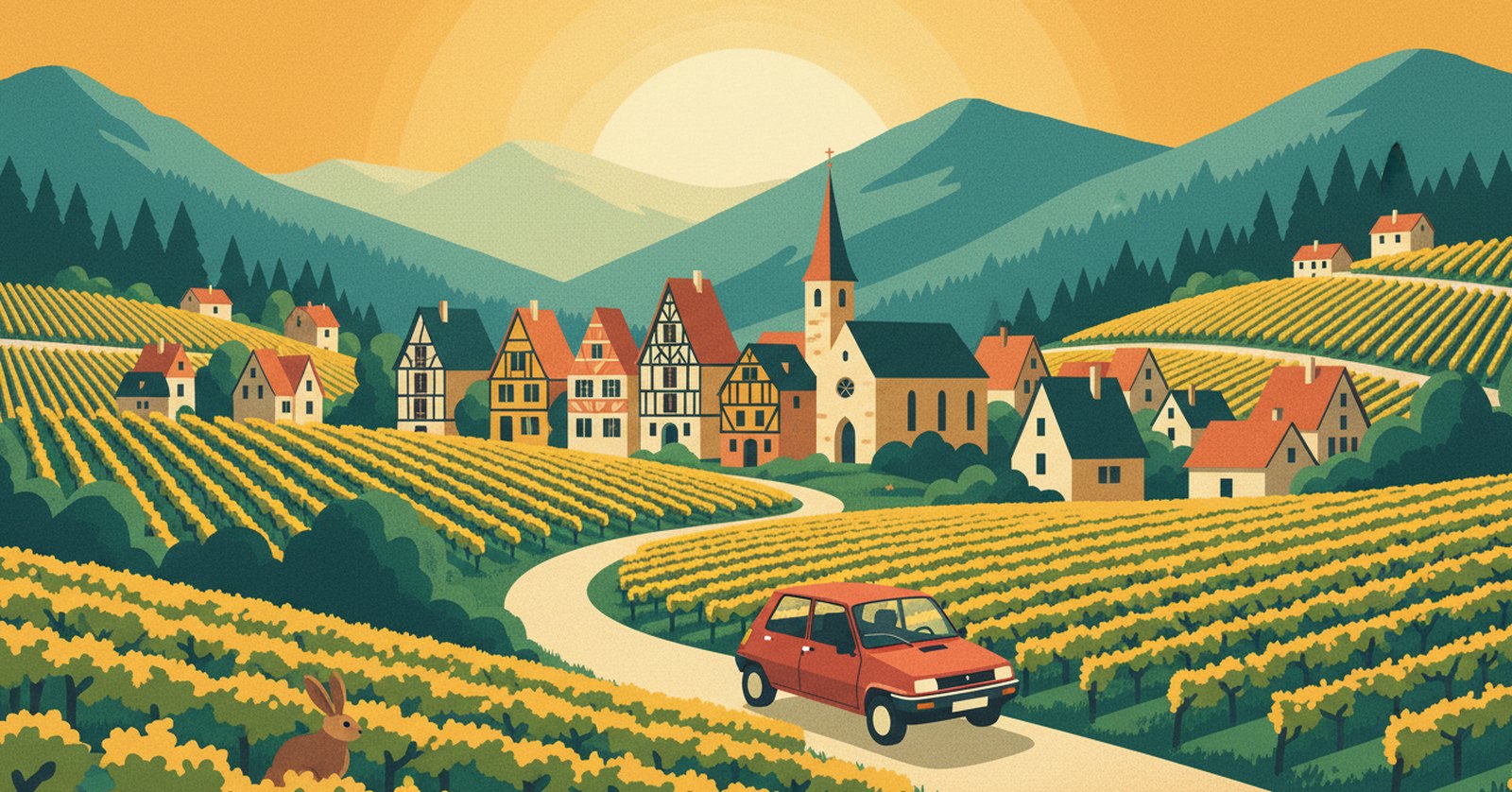
« Here the way around is a destination in itself: you avoid a city by driving through a vineyard. »
Why driving through Strasbourg is such hard work
Strasbourg is wedged between the Rhine to the east and the Vosges to the west: all the north–south traffic of the Alsace plain funnels into a narrow corridor, and the A35 follows it straight through the city from end to end.
It is also the one large French city whose official bypass is tolled: the western bypass, the A355, is a toll motorway. The free alternative is to drive through. So you end up choosing between paying and plunging into the city, when you were only passing by.
In practice, La Route Buissonnière keeps you off :
- the A35, which crosses the built-up area from north to south;
- the tolled A355 bypass and the A4 as they close in on the city;
- the dense drive through the Strasbourg built-up area.
An illustrative diagram, drawn in our own style. La Route Buissonnière does not use live traffic data.
Routing around Strasbourg in three steps
- Open La Route Buissonnière and enter your start and destination (say, Haguenau → Colmar).
- Add Strasbourg as a city to avoid, or simply let the app route around it.
- Follow the route: it takes you along the back roads, well clear of the city.
A real example: Haguenau → Colmar without the A35
- Leaving Haguenau, you head west across the Kochersberg — Durningen, Dossenheim-Kochersberg — the loess plateau they call the granary of Alsace.
- You reach the Bruche at Dachstein and Griesheim-près-Molsheim, at the mouth of the valley, well clear of the motorway plain.
- You pick up the foothills at Obernai, then Gertwiller and Epfig: this is the wine road, with the slopes rising on your left and the Vosges closing the horizon.
- You finish through Beblenheim, in the heart of the grands crus, then Houssen before entering Colmar — the A35 never touched, the toll never paid.
What this detour costs, measured
- Standard route, motorway allowed: 100.0 km · 1 hr
- La Route Buissonnière, buissonnière profile (our scenic setting): 114.3 km · 2 hr 11 min
- The extra we own up to: +14.3 km · +1 hr 11 min
- Closest approach to the centre of Strasbourg: 9.8 km on the standard route, 14.2 km on ours
Measured on 4 August 2026 using La Route Buissonnière's own routing engine, with Strasbourg set as a zone to avoid. Every town named above lies on the actual route; the app recalculates for your own start and destination. This drive is not faster, and it is not trying to be: the app does not use live traffic data.
Other drives where going around Strasbourg makes sense : driving the length of Alsace without the motorway plain; reaching the Vosges from the Bas-Rhin; linking Haguenau to the vineyards across the Kochersberg.
What you get for going around Strasbourg
The logic of the landscape changes. Instead of a plain crossed in a straight line, you follow an edge: wooded mountains on one side, terraced vines stepping down on the other. Villages arrive every few kilometres, with their half-timbering, their wrought-iron signs and their cobbled courtyards. You drive a little slower, you look a great deal more, you wind the window down.
It is a route that makes you want to stop, and that is precisely the problem: you leave later than planned. The road here is no longer time lost — it is already the journey.
Why doesn't La Route Buissonnière go through the centre?
Frequently asked questions
Enter your start and destination in La Route Buissonnière and add Strasbourg as a city to avoid: the route then swings towards the Vosges foothills, through the Kochersberg and the wine road, without using the A35.
Not with this route. The A355 bypass is a toll motorway; our verified route runs further west again, on free secondary roads — and an option lets you avoid all tolls anyway.
On our Haguenau → Colmar example, going around Strasbourg adds 14.3 km and 1 hr 11, measured on 4 August 2026. Most of the extra time comes from driving through the wine villages rather than past them.
See also
La Route Buissonnière · an independent project, made in France, with no advertising.